
Nature’s Fiber Against Cancer: The Science Behind Mushroom β-Glucans
“Let food be thy medicine and medicine be thy food.” — Hippocrates
For centuries, mushrooms have been valued not only as food, but also for their medicinal potential. Today, modern research is beginning to explain why.
One group of compounds drawing major scientific attention is β-glucans — naturally occurring polysaccharides found in mushroom cell walls. Researchers are particularly interested in how these molecules may influence the immune system and support cancer research.
Why Mushrooms Matter in Human Health
Mushrooms are far more than culinary ingredients. Species such as Shiitake, Maitake, Reishi, and Turkey Tail contain bioactive compounds that influence multiple biological pathways associated with immunity, inflammation, and cellular health.
Researchers classify many mushroom-derived β-glucans as biological response modifiers (BRMs). Rather than directly attacking cancer cells in the same way as chemotherapy drugs, BRMs work by influencing the body’s immune system and improving its ability to recognize and respond to abnormal cells.
This distinction is important. It positions mushroom β-glucans not as miracle cures, but as scientifically interesting compounds that may complement broader therapeutic effects. (Khan et al., 2018) The figure below represents different mushrooms and their β-glucans that are available in the global market.

What Exactly are β-Glucans?
β-glucans are long-chain polysaccharides composed primarily of glucose molecules linked together through β-glycosidic bonds. Their biological activity depends heavily on their molecular structure, including:
Branching patterns
Molecular weight
Solubility
Source organism
In mushrooms, β-glucans are typically β-(1→3) and β-(1→6)-linked polysaccharides. These structural features are believed to be central to their immunological effects.
How β-Glucans Interact with the Immune System
One of the most compelling aspects of mushroom β-glucans is their interaction with immune receptors.
Scientific studies suggest that β-glucans bind to receptors such as:
Dectin-1
Toll-like receptors (TLRs)
Complement Receptor 3 (CR3)
Once activated, these signaling pathways can stimulate several immune cell populations, including:
Macrophages
Dendritic cells
Natural killer (NK) cells
Neutrophils
This activation may enhance immune surveillance and promote a more coordinated immune response.
The Link between β-Glucans and Cancer Research
Cancer remains one of the world’s leading health challenges, driving continued interest in therapies that can support immune function while minimizing toxicity.
Research into mushroom β-glucans has produced encouraging findings in several experimental and clinical settings. Studies have reported:
Enhanced activity of natural killer cells
Improved macrophage response
Increased cytokine signaling
Potential support for conventional cancer therapies
Some mushroom-derived compounds have already been incorporated into integrative oncology approaches in countries such as Japan and China. The figure below depicts how β-glucans activate the immune system and destroys the cancer cells (Wong et al., 2011).
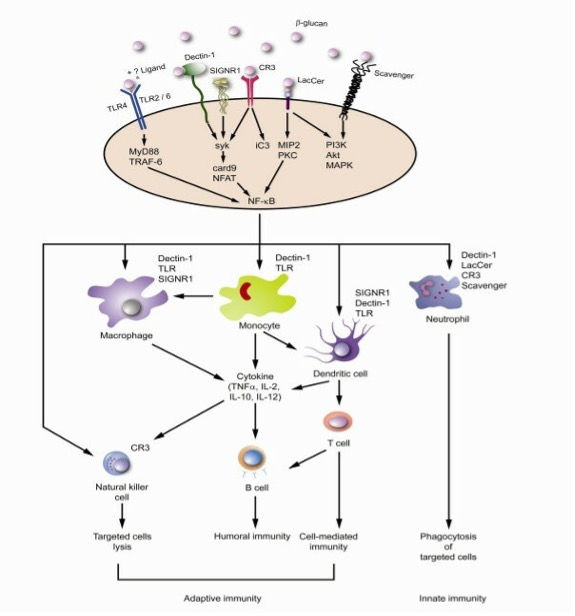
The major mushroom β-glucans which are used for pharmaceutical preparations in various Asian countries are enlisted as under:
Lentinan, derived from Lentinus edodes
Krestin from Coriolus versicolor
Schizophyllan from Schizophyllum commune
Pleuran from Pleurotus ostreatus
Grifolan (GRN) from Grifola frondosa
Chihara et al., 1970 who demonstrated that the lentinan showed the antitumor activity was greater than other mushroom polysaccharides and is given as an adjunct to chemotherapy. Importantly, researchers continue to emphasize that outcomes vary depending on the mushroom species, extraction method, dosage, and patient-specific factors.
Why Structure Matters
Not all β-glucans behave the same way. Their effects depend on structural features such as branching patterns, molecular size, and solubility.
This helps explain why some mushroom extracts appear more biologically active than others and why researchers continue working to better understand which formulations may offer the greatest therapeutic potential.
The Future of Functional Mushrooms
The global interest in functional foods and evidence-based natural medicine continues to grow. Mushroom β-glucans sit at the center of this movement because they combine:
Nutritional value
Immunological relevance
Low toxicity profiles
Broad public interest
While much remains to be understood, the scientific community increasingly recognizes mushrooms as a promising area for translational biomedical research.
Future investigations will likely focus on:
Optimizing extraction and purification methods
Understanding structure–function relationships
Conducting large-scale clinical trials
Developing personalized therapeutic applications
Final Thoughts
Mushroom β-glucans are a compelling example of how naturally occurring compounds can interact with complex biological systems.
While they are not cures for cancer, research suggests they may help support immune function and complement broader therapeutic approaches.
As scientists continue exploring the links between nutrition, immunity, and disease, mushrooms are emerging as more than just a culinary ingredient — they are becoming an increasingly important focus in modern biomedical research.
References
Chan, G. C. F., Chan, W. K., & Sze, D. M. Y. (2009). The effects of beta-glucan on human immune and cancer cells. Journal of Hematology & Oncology, 2(1), 25. https://doi.org/10.1186/1756-8722-2-25.Khan, A.A., Gani, A., Khanday, F.A., & Masoodi, F.A. (2018). Biological and pharmaceutical activities of mushroom β-glucan discussed as a potential functional food ingredient. Bioactive Carbohydrates and Dietary Fibre, 16 1-13. https://doi.org/10.1016/j.bcdf.2017.12.002
Khan, A. A., Gani, A., Masoodi, F. A., Mushtaq, U., Naik, A. S. (2017). Structural, rheological, antioxidant and functional properties of β-glucan extracted from edible mushrooms Agaricus bisporus, Pleurotus ostreatus and Coprinus attrimentarius. Bioactive Carbohydrates and Dietary Fibre, 11, 67-74. https://doi.org/10.1016/j.bcdf.2017.07.006
Wasser, S. P. (2011). Current findings, future trends, and unsolved problems in studies of medicinal mushrooms. Applied Microbiology Biotechnology, 89, 1323–1332. https://doi.org/10.1007/s00253-010-3067-4
Wong, K. H., Lai, C. K. M., Cheung, P. C. K. (2011). Immunomodulatory activities of mushroom sclerotal polysaccharides. Food Hydrocolloids, 25, 150–158. https://doi.org/10.1016/J.FOODHYD.2010.04.008
Chihara G., Maeda Y., Hamuro J., Sasaki T., Fukuoka F. (1970). Fractionation and purification of the polysaccharides with marked antitumor activity, especially lentinan from Lentinus edodes. Cancer Research, 30, 2776-2782. https://www.scirp.org/reference/referencespapers?referenceid=2534924
About the Author
Dr. Asma Ashraf Khan is a food technologist, researcher, and academic leader with a Ph.D. in Food Technology and dual master’s degrees in Food Technology (Food Microbiology) and Dietetics & Food Service Management (Public Health Nutrition). She serves as Assistant Professor at Shoolini University, mentoring graduate and MTech students while advancing research in functional foods and bioactive compounds. Beyond academia, she is Director of Food Innovate Pte Ltd, leading translational projects in β‑glucan innovation, nutraceuticals, and sustainable food systems. Her academic leadership extends to international presentations, peer‑reviewed publications, and regulatory advisory roles, positioning her as a global voice in science‑driven nutrition and culturally inclusive public health. Dr. Khan is also a Nutrition Expert at NTUC Health Singapore and Council Member at MKAC, actively contributing to culturally inclusive public health and global food innovation.



Comments